

Well that backfired (part 1)
The issue on my mind is when seemingly clever estate planning is mucked up because the planning ended with the oldest generation and a younger beneficiary unexpectedly dies first.

We are all used to things that are short and sweet, but today’s topic is abruptly sour. I’m fortunate that it hasn’t been an issue with my clients, but it is top on the list of things to avoid at the moment.
The issue on my mind is how seemingly clever estate planning is mucked up because the planning ended with the oldest generation and a younger beneficiary unexpectedly dies first.
This situation typically doesn’t affect financial assets and their payable on death designations. Instead, it hits the hardest on real estate.
Clients frequently inquire about the best way to pass cabin property to their children and grandchildren. There are a variety of reasonable options: a few people choose to sell the property to their children, some gift it to the next generation, and others create trusts to get the job done. (Occasionally lawyers recommend forming LLCs now, but I have yet to take that approach.) Any of these methods can be appropriate; the choice is heavily influenced by available cash flow, anticipated medical needs, and goals for the land.
The problem arises when long-term planning results in the transfer of property — home, cabin, land, etc. — to someone who doesn’t have an estate plan addressing his or her new property. If the new owner dies, the property would be passed to her heirs at law (or perhaps to an unintended recipient from a decades-old will). This might include the original property owner’s grandchildren, but, in the event of a whole family accident, could easily result in the son-in-law’s parents owning part of the land as well. Ironically, property titled in unmarried children’s names often goes back to the person who was trying to pass it out of his or her estate to begin with!
Bottom line — when parents of adult children are planning for their estates, the children should also make estate plans that reflect those decisions.
*This is not legal advice, just food for thought.
**For my hungrier readers who need more food: One potential solution is to file a transfer on death beneficiary designation each time there is a new owner, which I often recommend, but you would be surprised how many people are “gonna sell it really soon” and never get around to it.

Thinkity think thank thunk
Prescott High School presents Seussical the Musical this weekend at the Prescott Performing Arts Center — join me in supporting our students in their theatrical endeavors! … Meanwhile, I revisited “Oh, the Places You’ll Go” for the first time since my high school graduation, and found myself thinking about estate planning instead of getting all sentimental.
Prescott High School presents Seussical the Musical this weekend at the Prescott Performing Arts Center — join me in supporting our students in their theatrical endeavors!
While a few Dr. Seuss books were a significant part of my childhood — my dad still recites “One Fish, Two Fish” from memory, now for my kids — many remain unfamiliar to me. In preparation for the show, my six-year-old has been scouring the library shelves in an effort to get to know Horton, Judge Yertle, the Wickersham Brothers, and other characters we haven’t met yet.
Meanwhile, I revisited “Oh, the Places You’ll Go” for the first time since my high school graduation, and found myself thinking about estate planning instead of getting all sentimental. In particular, this quote stood out to me: “You have brains in your head and feet in your shoes, you can steer yourself any direction you choose!”
There are always several options on how to handle your finances and property. One thing that is non-negotiable, however, is that my clients need to have enough information to comfortably make their own decisions. When it comes to estate planning, you are the best person to choose the proper direction for your family. I am happy to help you map out a couple of routes … but when it is time to steer, you will be in the driver’s seat.
———————-
After the show this weekend, I am sure to have the song “Oh, the thinks you can think!” stuck in my head, so here is a preview of the “thinks” I will be writing about next week:
Some of the most heartbreaking issues I see involve small estates where $15,000 could have been passed on to heirs by filling out a simple form, and instead they are left sorting out money between creditors. While having a will is essential, the most important decisions you make involve managing your property and bank/investment accounts in such a way that your will serves as more of a safety net than a set of instructions.

the Right Time to do the Right Thing
Sure, I could come up with a grand plan for always showing up on time, eating healthier/exercising more, and keeping my house perfectly clean, but reality says that (1) none of those things were going to happen like clockwork beginning on January 1st, (2) my kids are 6 and 2, and adamantly against all three of those goals, and (3) I don’t need perfection; I need improvement. What I really want to do is start making better choices every time I have the opportunity to do the right thing.
Throughout my life I’ve sat through many lectures, ceremonies, and sermons. While I can tell you the content of many lectures and a good deal of sermons, I’m fairly certain I recall nothing that was said during my four commencements, my wedding, or any of the events I sat through as a musician over the years.
Some lectures stuck with me because of the subject, and others because of the professor. One of my favorites was a college science class in which we read the book The Making of the Atomic Bomb by Richard Rhodes — it was the first massive book I ever read, and the discussion was interesting and history in it valuable. Another eye-opening experience was spending January 2000 learning about World War I from two wonderful professors; I still recite In Flanders Fields every Memorial Day, and now my children know it as well. My elementary music education class required students to lead each other in singing children’s songs and rhymes such as Wee Willie Winkie. We felt ridiculous, but learned so much that it took years for me to truly value it all.
Sermons may be a little more difficult to recall as a whole, but some special moments from church services stand out to me. Pastor Rick Reynolds once made reference to the quote, “Preach the gospel to everyone you meet; use words if you have to,” on a Wednesday night when I was in high school. It immediately made a huge impression on me, and I still have the piece of paper on which I wrote it. I also think back to a message Rev. Shane Bishop gave on how our religious perspective is shaped not only by the Bible, but also by our own reason, tradition, and experience. Upon hearing it I was immediately skeptical, but it has crossed my mind regularly over the last 15 years, helping me become more empathetic and refrain from self-righteousness.
Ceremonies, on the other hand, always seem … boring. Once I was tasked with playing a drum roll for the entirety of Pomp & Circumstance. Most ceremonies are every bit as monotonous to me as that snare drum part. Bleh.
As I contemplated writing resolutions on New Year’s Eve, however, I was reminded of the words Minnesota Supreme Court Justice David Stras said (paraphrasing Martin Luther King, Jr.) on the day I was sworn into the Wisconsin Bar: “There is never a bad time to do the right thing; it is always the right time to do the right thing.”
I paused. I didn’t need a resolution to work on this year.
Sure, I could come up with a grand plan for always showing up on time, eating healthier/exercising more, and keeping my house perfectly clean, but reality says that (1) none of those things were going to happen like clockwork beginning on January 1st, (2) my kids are 6 and 2, and adamantly against all three of those goals, and (3) I don’t need perfection; I need improvement. What I really want to do is start making better choices every time I have the opportunity to do the right thing.
In my law practice I was surprised to find that having wills drawn up is a popular resolution. Since the beginning of the year I’ve already had more phone calls from new clients than I did in my first six months of business. Along with those who are getting things taken care of because that was their plan to start 2019, however, was a call from the family of a man who passed away unexpectedly at age 61 with his will unsigned. It was heartbreaking to explain that even though he had it drawn up by a lawyer, if the will isn’t signed and witnessed properly, then he died without a will.
Putting an estate plan together usually takes a meeting or two, plus a signing conference. Yes, there are beneficiary designations to confirm and often a transfer on death deed to record, but for the most part it takes two or three hours of your time over the course of a month while your lawyer helps you through the paperwork. Getting your estate plan in order — and avoiding the confusion and frustration my clients are facing at the moment — is the right thing to do.
And if it’s the right thing to do, then it’s the right time to do it.
(Okay, a couple of disclaimers so I don’t get in trouble with friends and family: My very first memory of a ceremony was my brother, Larry, giving a speech at his graduation … and it was actually funny because he messed up and said, “Rewind,” but that is literally the only word of his speech I remember. Also, my wedding wasn’t boring, but it was insanely windy that day and it was all I could do to stand up straight and keep my heels from sinking into the wet grass!)
Hanging my Shingle
My reason for wanting G'Pa to be alive as I open my law practice, though, is quite different than the desire for him to have met my husband and children or to see me graduate from law school or to congratulate me on winning an election against a long-time incumbent. I wish he was still here so I could have helped him lay out his estate plan.
My new adventure has begun! Along with thanking the wonderful people who helped me on this journey of setting up my new law practice (notably my family, Debbie, Frank, and Max), I will take this opportunity to tell you about one of my favorite people ever.
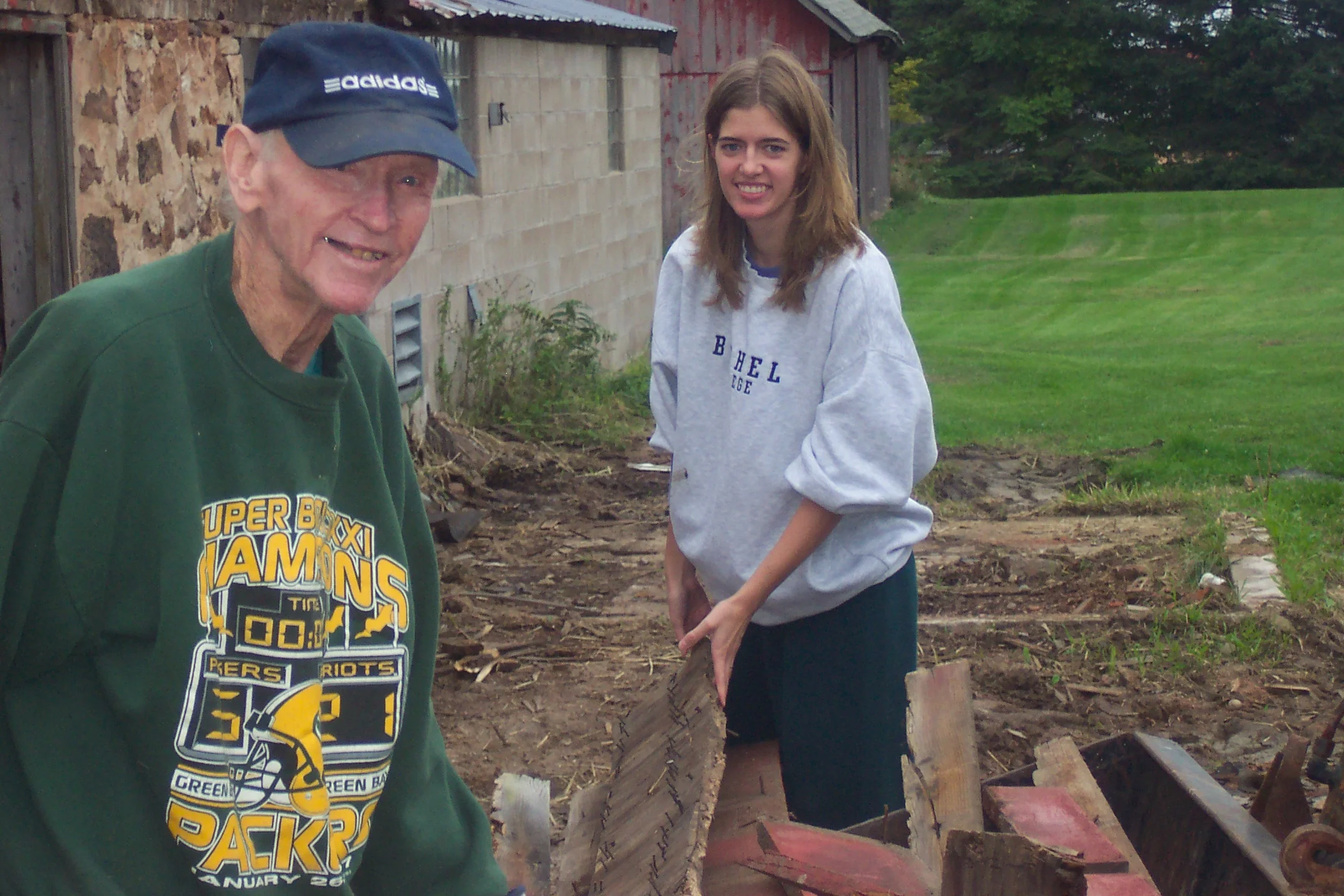
Oh, how I wish my G'pa were here to see this. Evert Joling was an incredible man. His sense of humor was impeccable, he carried himself with a gentle confidence, he loved God with his whole heart, he was brilliant despite only being formally educated through 8th grade, and he was sick of Brett Favre long before #4 was traded to the Jets. We can only be thankful he passed away several years before Favre went to the Vikings.
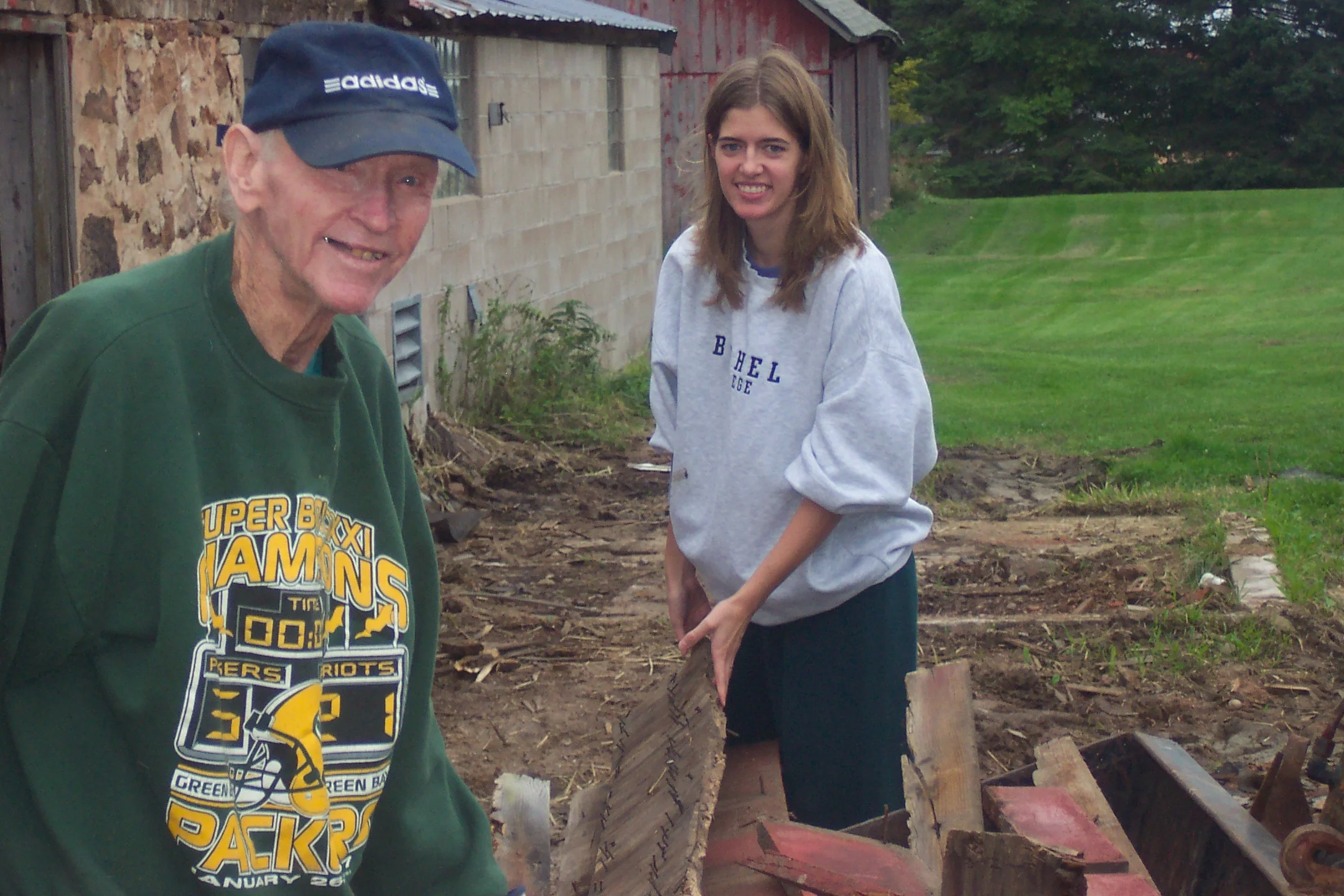
Working on the farm with G'pa two months before he passed away.
I vividly remember crying when I found out G'pa's cancer prognosis gave him six months to live; I was so sad and angry that he would probably die before I ever had the chance to have a baby. I felt a similar frustration again when I was elected town chair of the Town of Oak Grove board -- I wanted him to witness these milestones! For years I had listened to his stories as a town supervisor, watched him pour over Wisconsin Towns Association magazines, and eventually took him to town meetings when he was too weak to drive. He would have been so pleased to see me following in his footsteps. (He might have also been that one constituent who sent a note offering me "encouragement" in my new position because of the challenges I would face considering my age, gender, choice of profession, and length in residence. Thanks ... I think.)
My reason for wanting G'pa to be alive as I open my law practice, though, is quite different than the desire for him to have met my husband and children or to see me graduate from law school or to congratulate me on winning an election against a long-time incumbent. I wish he was still here so I could have helped him lay out his estate plan.
Whenever I talk about my transition from being a stay-at-home mom to actively practicing law, I point out that I am surrounded by parents of young children who have no provisions in place if they were to unexpectedly pass away — this is a natural motivation for choosing wills and trusts as the focus of my lawyering.

What I don't talk about very often is the day my grandpa asked me to get a paper and pen out so he could dictate a document that he intended to be a will, or at least a legally binding transfer of property. I was a 25-year-old graduate student finishing a degree in music performance; I had no clue what he was even trying to accomplish. The gist of it was that he had a computer upstairs with internet access, and his googling (or whatever we called it in 2005) led him to believe that he could create a seamless succession plan for his farm assets. This, of course, made my grandma irritated because she didn't understand it either, and nothing ended up getting done. The part that will forever echo in my head is him saying, "Can't a dying man get his wish?" Apparently not, Pa. I'm so sorry.
Personally, I think every American should be able to calculate his own taxes and draft her own will, but that isn't the reality of the world we live in today. Often times it takes an accountant or a lawyer to guide us through these essential tasks. My goal is to make the process approachable — I speak in a manner that is straightforward, I use words that are easy to understand, my fees are reasonable, and when you come into my office, I will provide the information but let you decide what is best for your situation.